
Take the time to drive through Auvergne-Rhône-Alpes, stop in the villages, drive through volcanic landscapes, and discover heritage sites along the way: that’s the idea behind the Grand Tour. Spanning 28 stages and over 3,000 kilometers of routes, this regional road trip connects the region’s major natural and cultural sites.
Between Montbrison and Brioude, the route passes through the Livradois-Forez region on its way to the Abbaye de La Chaise-Dieu, nestled in the heart of the Haute-Loire countryside.
The Grand Tour: a region to explore at your own pace
The idea is simple: follow a route designed to connect the landscapes and places that tell the story of Auvergne-Rhône-Alpes. You’ll travel from an Alpine pass to a historic town, from a lake to a vineyard, and from a stone village to a protected natural site.
Each stage begins in a city, passes through several points of interest, and ends at a new destination. You’re free to stop along the way to have lunch on a terrace, walk to a lookout point, visit a landmark, or spend the night there.
A stage of the Grand Tour through charming villages and wide-open spaces
The route between Montbrison and Brioude winds through the Livradois-Forez Regional Nature Park for 113 kilometers, passing through a mix of coniferous forests, basalt formations, rivers, and hilltop villages. This stage of the Grand Tour connects the Loire to the Haute-Loire via secondary roads that invite you to explore the region at your own pace, taking in the scenery and cultural stops along the way.
The route begins in Montbrison, an ancient medieval town in the Forez region, known for its narrow, historic streets, its riverbanks, and its market, where you can find Fourme de Montbrison AOP cheese. Gradually, the plains give way to the hills of Livradois-Forez and the landscapes of the low mountains. The route winds through a region rich in craftsmanship, where artisans, producers, and small local businesses enhance the journey.
The road then leads to Marols, a charming village that has become a haven for artists. Behind its ramparts and stone houses, the narrow streets are home to studios, murals, and cultural events set against a mid-mountain backdrop. Further on, Saint-Bonnet-le-Château appears on its rocky promontory. Its cobblestone streets, historic houses, and Gothic collegiate church overlook the landscapes of the Forez region all the way to the Auvergne mountains.
In the heart of the Livradois-Forez Regional Nature Park, the roads wind through heathlands, forests, and streams. The panoramic views sometimes open up to the Chaîne des Puys in the distance, while opportunities for hiking and walking abound along the route. A detour to Lavaudieu also offers a chance to discover another side of the Haute-Loire, with its winegrowers’ houses, Romanesque abbey, and peaceful banks of the Senouire.
The route ends in Brioude, on the banks of the Allier River, between Clermont-Ferrand and Le Puy-en-Velay. Listed among the Most Beautiful Detours of France, the town blends history and nature in a setting defined by the river. In the historic center, colorful facades surround the Basilica of Saint-Julien-de-Brioude, the largest Romanesque church in Auvergne, known for its polychrome stones and contemporary stained-glass windows. Nearby, the Maison de Mandrin, the Hôtel de la Dentelle, and the Center for Architecture and Heritage offer further cultural discoveries.
Located at the gateway to two regional nature parks, Brioude also offers a variety of landscapes perfect for outdoor activities, including hiking, biking, canoeing, and walks along the Allier River. But before you get there, be sure to visit a must-see stop along the route: La Chaise-Dieu Abbey.
La Chaise-Dieu Abbey: A Blend of Medieval Heritage and Cultural Programming
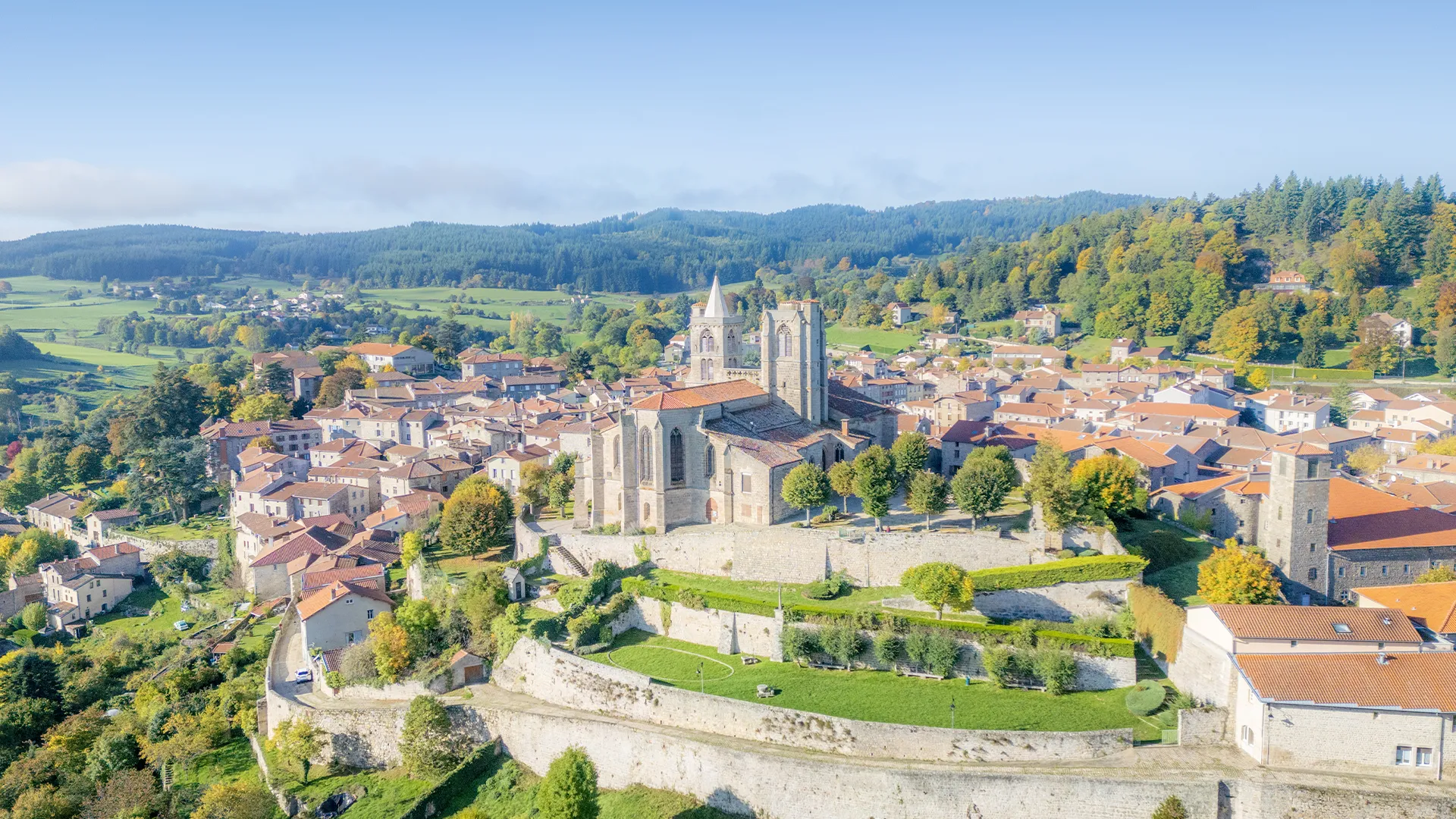
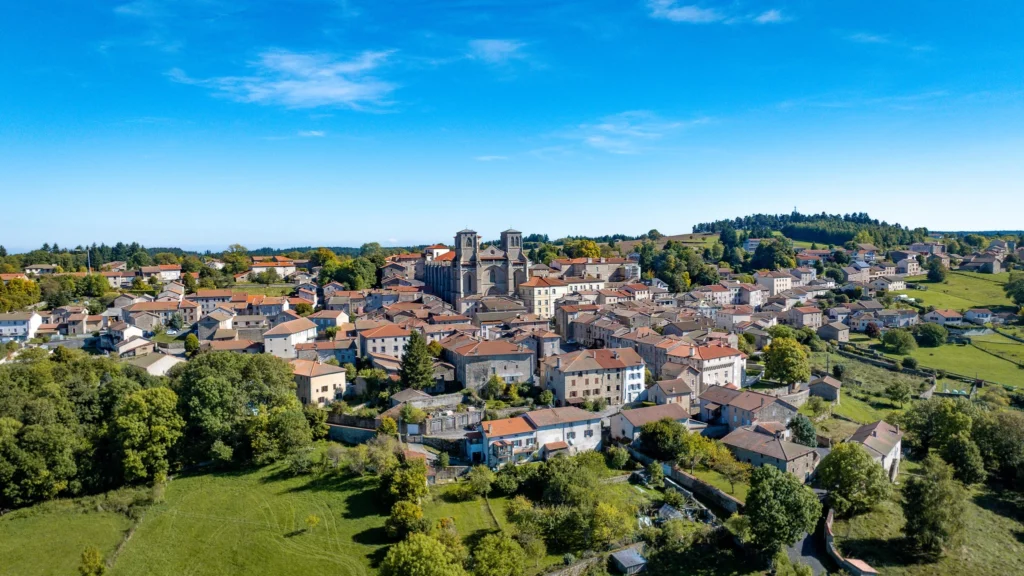
Perched at an altitude of over 1,080 meters, La Chaise-Dieu Abbey overlooks the medieval village that has grown up around it since the 11th century. Founded in 1043 by Robert de Turlande, a canon of Brioude, it arose from a monastic way of life based on poverty and simplicity. A Benedictine community formed around it, organized around prayer and work, giving rise to the Casa Dei, the “house of God,” which became La Chaise-Dieu.
A masterpiece of Southern Gothic architecture, the abbey is an architectural complex shaped by nearly a thousand years of history. The abbey church notably houses the tomb of Pope Clement VI, represented by a white marble recumbent figure on his black marble tomb, as well as a set of 144 monks’ choir stalls, featuring carved decorations populated by fantastical figures and symbolic elements drawn from the medieval imagination. The mural of the Dance of Death, created around 1430, extends this interpretation of the medieval world by depicting the universality of death across the various strata of society.
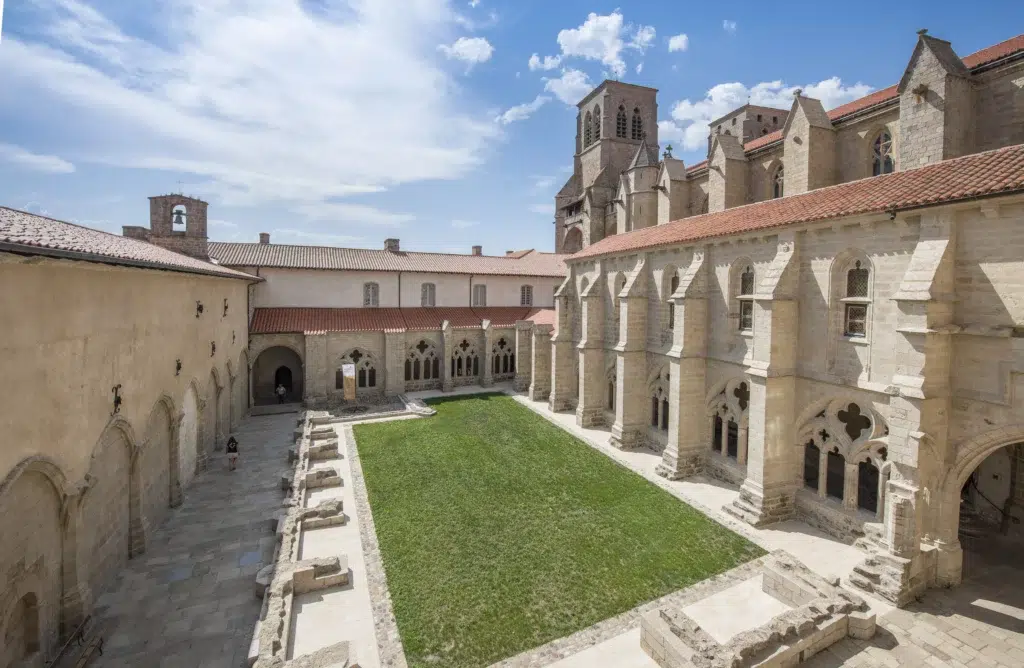
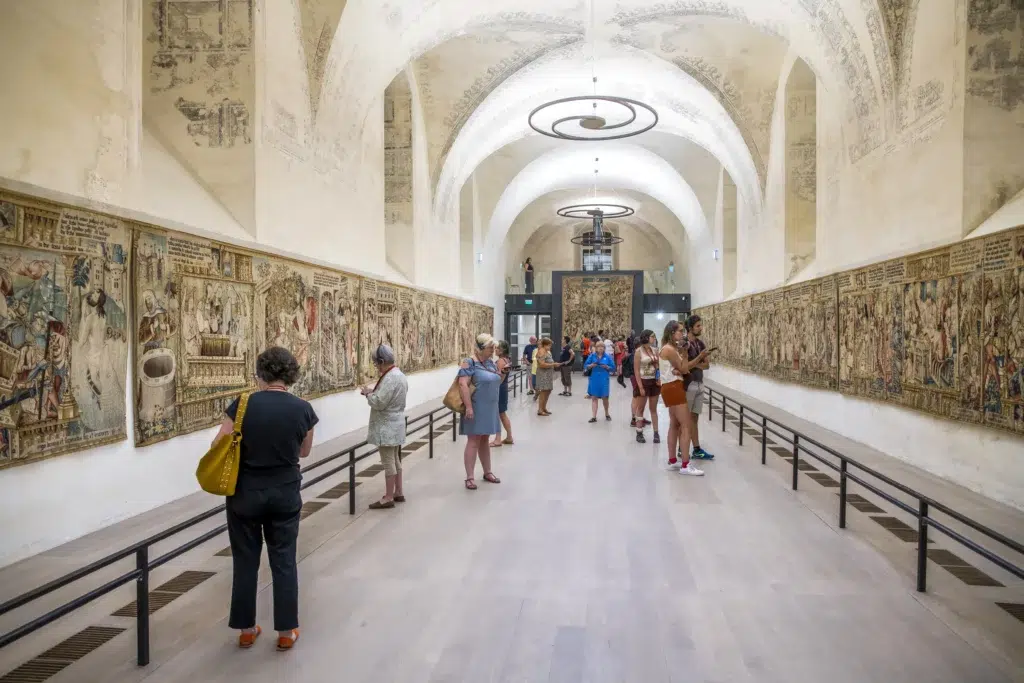
The tour continues through the convent buildings, including the cloister, which was built in several phases between the late 14th and 15th centuries, the Echo Room, built in 1682, and the rooms dedicated to Flemish tapestries, a collection of 14 pieces listed as Historic Monuments since 1840. This tapestry, which depicts episodes from the lives of Christ and the Virgin Mary, is displayed in a former chapel that was restored to showcase it.
The town also preserves several traces of its medieval development around the abbey, with historic houses still visible in the abbey district. The site is part of a visitor route enhanced by audio guides, themed tours, and accessibility features. In 2026, the abbey will host the photography exhibition Where It All Begins, presented in collaboration with Magnum Photos from May 1 to September 20. It brings together more than 60 portraits of 20th-century artists in their studios, including Andy Warhol, Frida Kahlo, Francis Bacon, and Yayoi Kusama, as seen through the lenses of photographers such as Martin Parr, Inge Morath, and Abbas. This program is part of a cultural season that includes, notably, the 60th La Chaise-Dieu Music Festival, the Organ Days, and other annual events at the site.
An app to make traveling easier
Le Grand Tour also offers a mobile app designed as a modern travel journal. It lets you pinpoint must-see attractions, track your progress, save your favorites, and discover recommendations along the way.
It’s convenient for making an impromptu stop or adjusting your itinerary based on the weather and how you feel at the moment.

The Grand Tour is best explored in small doses, depending on the season and your mood. Whether it’s a weekend getaway, a few days in the mountains, or a longer summer trip, everyone can tailor their journey to their own pace. More than just a journey, the Grand Tour offers a way of traveling where the landscapes you pass through, the stops, and the detours are an integral part of the experience.
Have a great trip in Auvergne-Rhône-Alpes!
Cover photo: En Velay Tourisme